Blog

  • The Harbor: A Symbolic Story for Self-Reflection

    The Harbor: A Symbolic Story for Self-Reflection

    Story of the Day from Empower Soul Path, Life Choices.

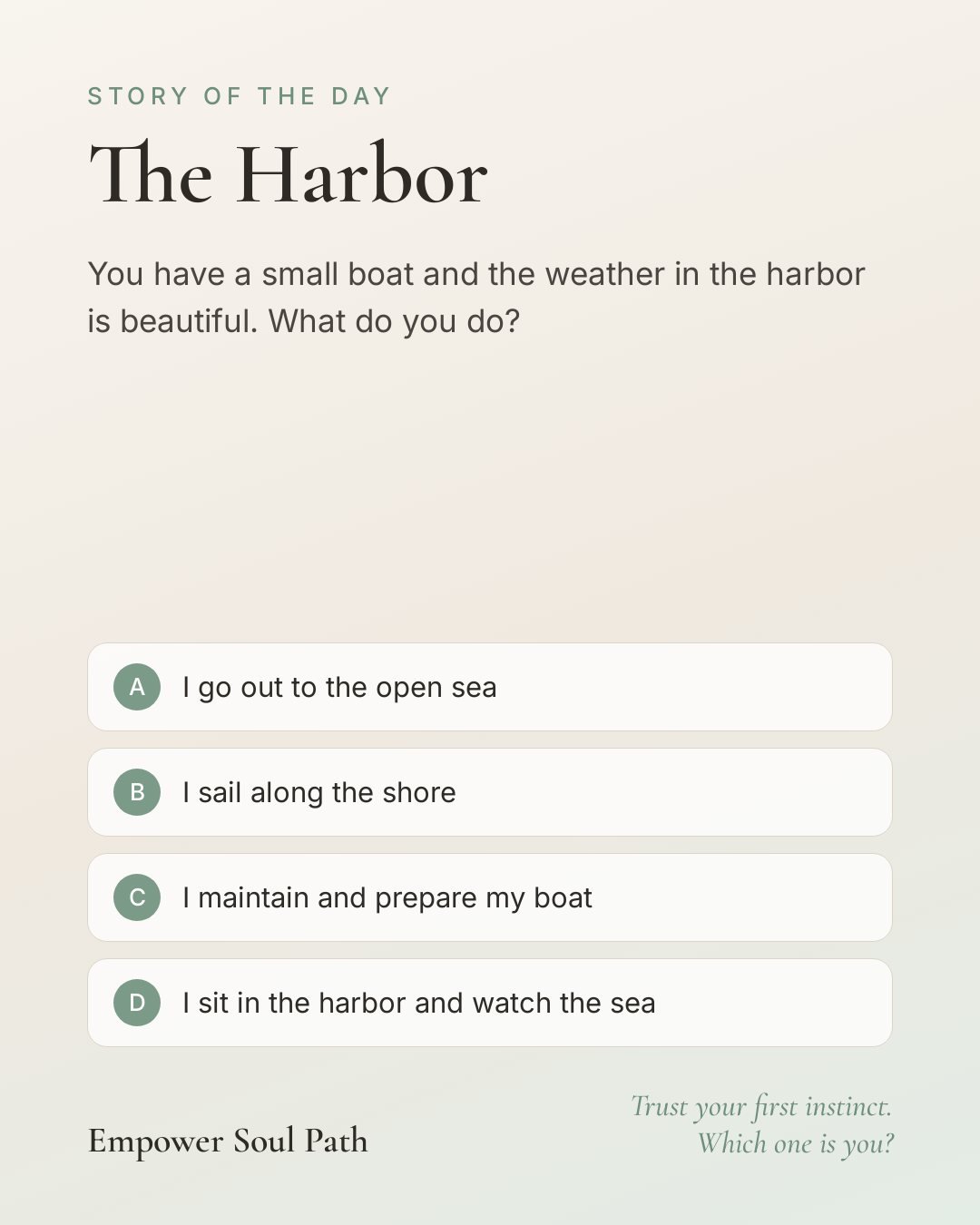
    You have a small boat and the weather in the harbor is beautiful. What do you do?

    What would you choose?

    A. I go out to the open sea
    B. I sail along the shore
    C. I maintain and prepare my boat
    D. I sit in the harbor and watch the sea

    Read the scene once, notice which answer your body leans toward first, and go with that. In symbolic stories every choice carries an image, and the image you reach for can say something about where you are right now. There are no right or wrong answers.

    Choose your answer and see what it may reflect: https://app.empowersoulpath.org/s/harbor_boat?lang=en

    A question to sit with

    Is there an area in your life where you want to sail into open waters? You can write your answer in a journal, or simply hold the question in mind during the day and notice what comes up.

    About symbolic stories

    Symbolic stories are short imagined scenes with a single choice. They are a gentle way to reflect on your inner world, your relationships and your patterns through images rather than analysis. They are a lens for reflection, not a personality test or a diagnosis.

    The Empower Soul Path app has 90 symbolic stories in 9 languages, a discovery journal that keeps your choices, and a monthly symbol map that shows the themes you return to. Try today’s story here: https://app.empowersoulpath.org/s/harbor_boat?lang=en

  • Two Offers: A Symbolic Story for Self-Reflection

    Two Offers: A Symbolic Story for Self-Reflection

    Story of the Day from Empower Soul Path, Life Choices.

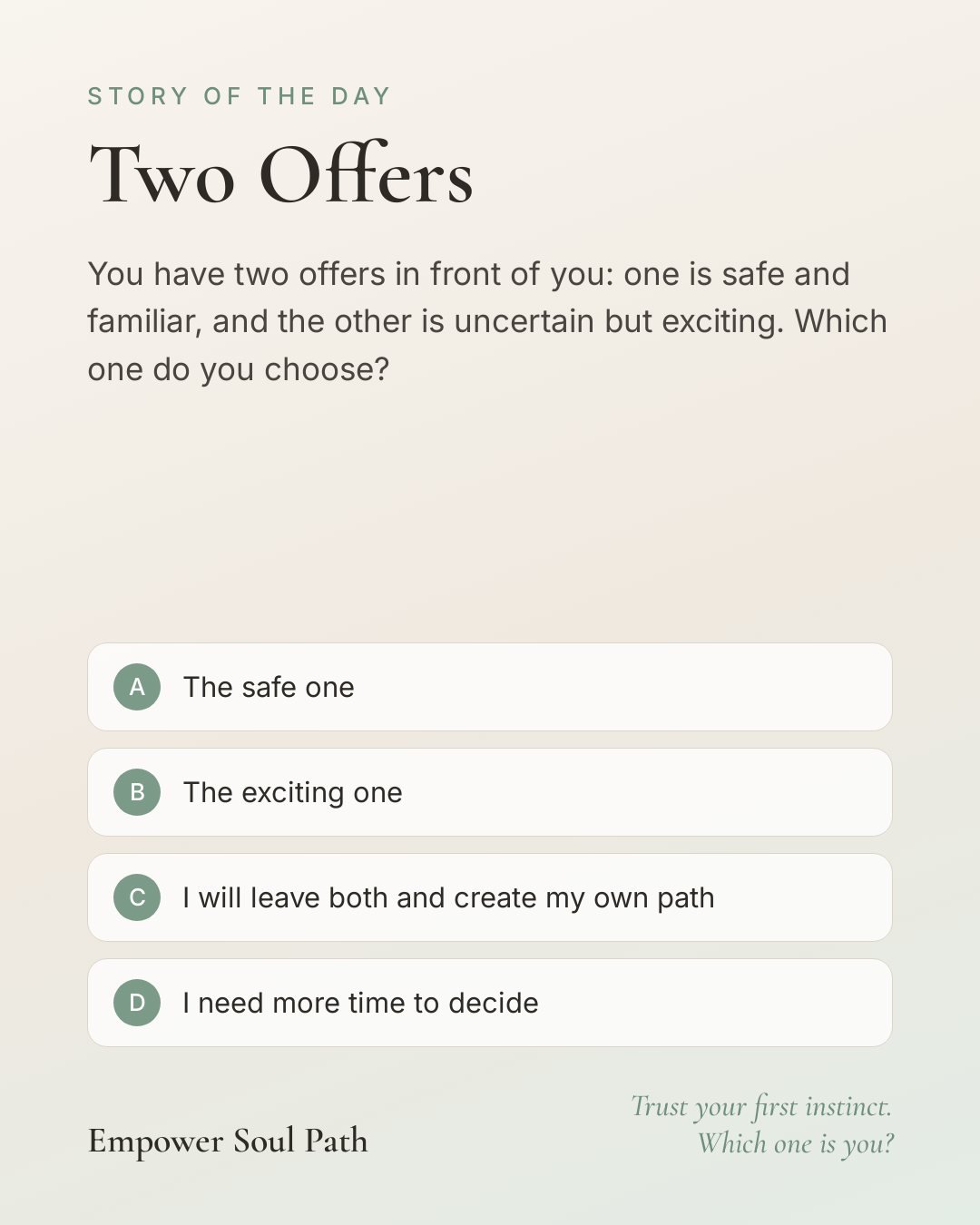
    You have two offers in front of you: one is safe and familiar, and the other is uncertain but exciting. Which one do you choose?

    What would you choose?

    A. The safe one
    B. The exciting one
    C. I will leave both and create my own path
    D. I need more time to decide

    Read the scene once, notice which answer your body leans toward first, and go with that. In symbolic stories every choice carries an image, and the image you reach for can say something about where you are right now. There are no right or wrong answers.

    Choose your answer and see what it may reflect: https://app.empowersoulpath.org/s/two_offers?lang=en

    A question to sit with

    Between security and excitement, which one do you need more right now? You can write your answer in a journal, or simply hold the question in mind during the day and notice what comes up.

    About symbolic stories

    Symbolic stories are short imagined scenes with a single choice. They are a gentle way to reflect on your inner world, your relationships and your patterns through images rather than analysis. They are a lens for reflection, not a personality test or a diagnosis.

    The Empower Soul Path app has 90 symbolic stories in 9 languages, a discovery journal that keeps your choices, and a monthly symbol map that shows the themes you return to. Try today’s story here: https://app.empowersoulpath.org/s/two_offers?lang=en

  • What Is a Somatic Mood Journal? How to Track Your Feelings Through Your Body

    Short answer: a somatic mood journal is a journal that tracks where you feel an emotion in your body, not only what you feel. Instead of writing “I felt anxious”, you write “I felt a tight chest and shallow breath before the meeting”. Over time, these body notes reveal patterns that a normal mood tracker can miss.

    “Somatic” comes from the Greek word soma, meaning body. A somatic approach starts from sensation: tightness, warmth, heaviness, lightness, buzzing. Many people find it easier to notice a sensation than to name a complicated feeling.

    How is it different from a regular mood tracker?

    • Regular mood tracker: you pick an emoji or a word, like “stressed” or “calm”.
    • Somatic mood journal: you note the feeling and the body location and the sensation, plus what was happening.

    That extra layer is where insight lives. You might discover that your stomach tightens every Sunday evening, or that your shoulders relax after a walk.

    Why track emotions through the body?

    • Earlier awareness: the body often signals stress before the mind names it.
    • Clearer patterns: locations and triggers repeat, and writing them down makes them visible.
    • Gentler response: once you know where you hold a feeling, you can respond with breath, movement or rest. See 5 gentle ways to listen to your body.

    A simple 3-minute daily template

    1. Mood: one word for how you feel right now.
    2. Location: where do you feel it? (head, throat, chest, stomach, shoulders, back, hands, legs)
    3. Sensation: tight, heavy, warm, hollow, buzzing, open, light.
    4. Context: what was happening just before?
    5. Need: what would help this part of you right now?

    Example: “Mood: overwhelmed. Location: shoulders and jaw. Sensation: tight and hot. Context: three messages in a row from work. Need: a 5-minute walk and one task at a time.”

    Journal prompts for body awareness

    • Where in my body do I feel most at ease today?
    • Which part of my body is asking for my attention?
    • When did I last feel my shoulders drop?
    • What does “safe” feel like in my body?
    • What is my body telling me that my mind keeps ignoring?

    For deeper prompts, try shadow work journaling prompts.

    Try a guided somatic mood journal

    The Empower Soul Path app was built around this idea. You tap where you feel an emotion on an interactive body map, log a 30-second check-in, read what that area may be telling you symbolically, and write with gentle daily prompts. Over time, your patterns become clearer. It works in 9 languages and on the web at app.empowersoulpath.org.

    Download it free on Google Play for Android or on the App Store for iPhone.

    Frequently asked questions

    What is a somatic mood journal?

    It is a journal that records where you feel an emotion in your body and what the sensation is like, alongside the mood itself, so you can notice patterns over time.

    What does somatic mean?

    Somatic means “of the body”. Somatic practices focus on bodily sensations as a way to understand and care for your emotional state.

    How often should I write in a somatic journal?

    Once or twice a day is enough. Three minutes is plenty. Consistency matters more than length.

    Is there an app for somatic journaling?

    Yes. Empower Soul Path combines a body map, mood tracker and private journal so you can log where you feel emotions and see patterns over time.

    A gentle note: this article is for reflection and self-awareness. It is not medical advice and does not replace professional care.

  • The Unmarked Crossroads: A Symbolic Story for Self-Reflection

    The Unmarked Crossroads: A Symbolic Story for Self-Reflection

    Story of the Day from Empower Soul Path, Life Choices.

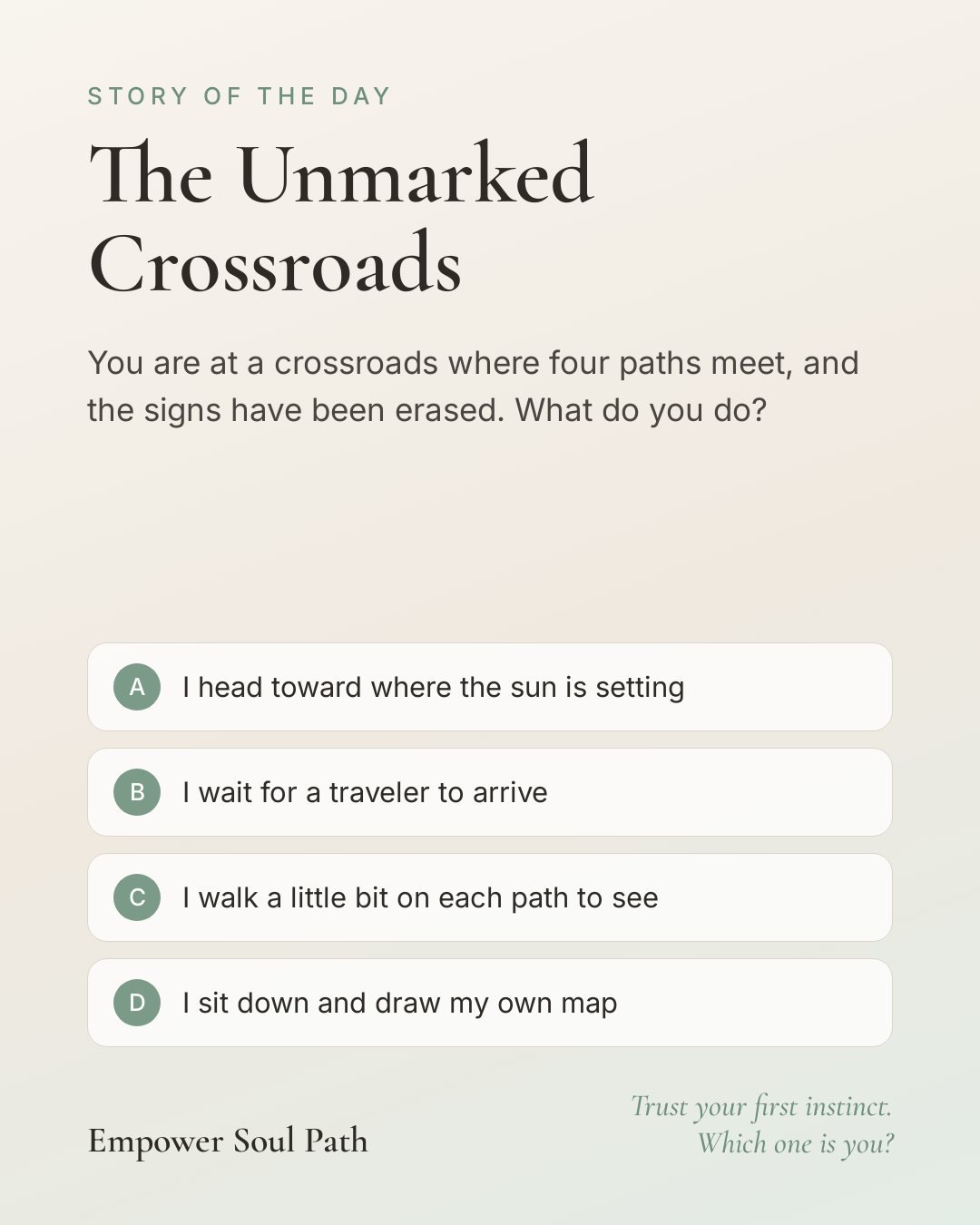
    You are at a crossroads where four paths meet, and the signs have been erased. What do you do?

    What would you choose?

    A. I head toward where the sun is setting
    B. I wait for a traveler to arrive
    C. I walk a little bit on each path to see
    D. I sit down and draw my own map

    Read the scene once, notice which answer your body leans toward first, and go with that. In symbolic stories every choice carries an image, and the image you reach for can say something about where you are right now. There are no right or wrong answers.

    Choose your answer and see what it may reflect: https://app.empowersoulpath.org/s/crossroads?lang=en

    A question to sit with

    At which crossroads are you in your life right now? You can write your answer in a journal, or simply hold the question in mind during the day and notice what comes up.

    About symbolic stories

    Symbolic stories are short imagined scenes with a single choice. They are a gentle way to reflect on your inner world, your relationships and your patterns through images rather than analysis. They are a lens for reflection, not a personality test or a diagnosis.

    The Empower Soul Path app has 90 symbolic stories in 9 languages, a discovery journal that keeps your choices, and a monthly symbol map that shows the themes you return to. Try today’s story here: https://app.empowersoulpath.org/s/crossroads?lang=en

  • Snake on the Path: A Symbolic Story for Self-Reflection

    Snake on the Path: A Symbolic Story for Self-Reflection

    Story of the Day from Empower Soul Path, Subconscious Symbols.

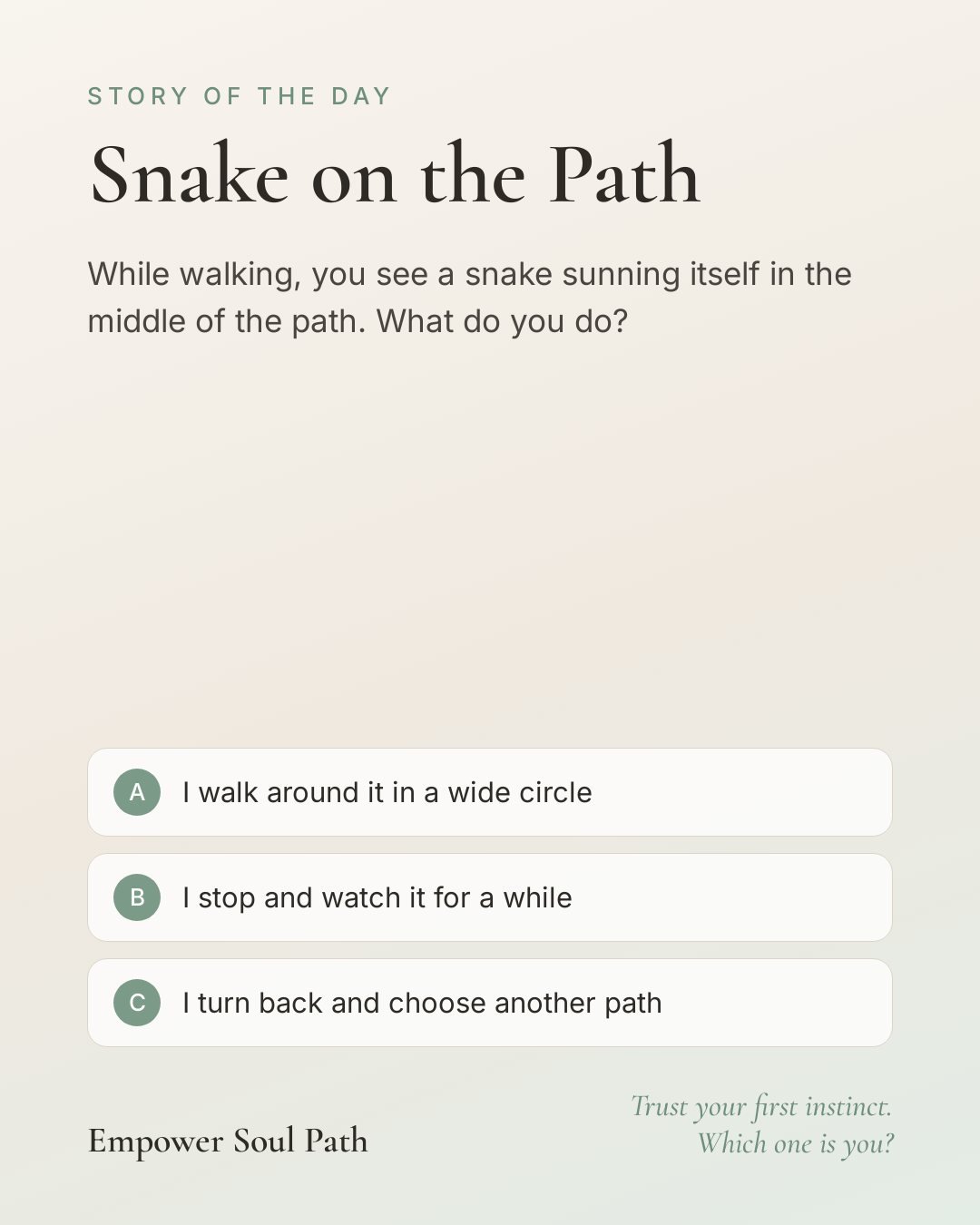
    While walking, you see a snake sunning itself in the middle of the path. What do you do?

    What would you choose?

    A. I walk around it in a wide circle
    B. I stop and watch it for a while
    C. I turn back and choose another path

    Read the scene once, notice which answer your body leans toward first, and go with that. In symbolic stories every choice carries an image, and the image you reach for can say something about where you are right now. There are no right or wrong answers.

    Choose your answer and see what it may reflect: https://app.empowersoulpath.org/s/path_snake?lang=en

    A question to sit with

    Is there an area in your life right now that is shedding its skin of change? You can write your answer in a journal, or simply hold the question in mind during the day and notice what comes up.

    About symbolic stories

    Symbolic stories are short imagined scenes with a single choice. They are a gentle way to reflect on your inner world, your relationships and your patterns through images rather than analysis. They are a lens for reflection, not a personality test or a diagnosis.

    The Empower Soul Path app has 90 symbolic stories in 9 languages, a discovery journal that keeps your choices, and a monthly symbol map that shows the themes you return to. Try today’s story here: https://app.empowersoulpath.org/s/path_snake?lang=en

  • Shoulder Tension and Emotions: What Tight Shoulders May Be Telling You

    Short answer: emotionally, tight shoulders are often linked with carrying too much: responsibility, worry, other people’s needs, or the feeling that you have to stay on guard. When we brace for stress, the shoulders lift toward the ears almost automatically. If that bracing never fully switches off, the tension stays.

    Physical reasons matter too, like posture, screens and sleep. But many people notice their shoulders rise on the days they feel most responsible, rushed or unsupported. Your shoulders may be one of the clearest messengers your body has.

    What shoulder tension may mean emotionally

    “I am carrying too much”

    We even say it in language: “the weight of the world on my shoulders”. Tension here often appears when you are holding responsibilities that feel heavy or that you did not choose.

    “I need to stay on guard”

    Raised shoulders are part of the body’s protective posture. When you feel you must watch out for what comes next, the shoulders stay lifted, ready.

    “I cannot ask for help”

    Some people carry tension when they feel they have to do everything alone. Noticing this can be a gentle invitation to share the load.

    Left shoulder vs right shoulder

    In body symbolism, some traditions link the right side with doing, giving and outer responsibilities, and the left side with receiving, feelings and inner life. These are reflective ideas, not rules. Use them as questions, not answers: “What am I carrying on this side right now?” For a broader look, see body symbolism: what your shoulders, back, stomach and more may be telling you.

    4 gentle ways to release shoulder tension

    1. Lift and drop: inhale and lift your shoulders toward your ears. Exhale and let them fall heavily. Repeat three times.
    2. Exhale longer: breathe in for 4 counts and out for 6 to 8 counts. A longer exhale helps signal safety to the body.
    3. Self-hold: cross your arms and rest each hand on the opposite shoulder. Give a gentle squeeze and breathe for one minute.
    4. Name the weight: ask “what am I carrying today?” and write down one thing you could put down, delegate or ask help with.

    For more practices, try 6 gentle somatic exercises for beginners or EFT tapping for beginners.

    Track your shoulder tension over time

    Patterns are easier to see when you write them down. Each time your shoulders feel tight, note the time, what was happening and how you felt. After a week, you may notice it always shows up during certain meetings, conversations or times of day.

    The Empower Soul Path app makes this simple: tap your shoulders on the body map, log how you feel, and explore what that area may be telling you, with a short guided practice for the moment.

    Download it free on Google Play for Android or on the App Store for iPhone.

    Frequently asked questions

    What emotion is stored in the shoulders?

    Shoulder tension is most often linked with responsibility, worry and the feeling of having to stay on guard. Everyone is different, so notice what is happening in your life when the tension appears.

    Why do my shoulders tense up when I am stressed?

    Lifting the shoulders is part of the body’s natural protective response. Under stress the muscles brace, and if the stress continues, they can stay tight.

    How can I relax my shoulders quickly?

    Lift your shoulders on an inhale and let them drop on a long exhale, three times. Then let your jaw soften and feel your feet on the floor.

    When should I see a professional about shoulder pain?

    If pain is severe, constant, follows an injury, or comes with numbness or other symptoms, please see a healthcare professional.

    A gentle note: this article is for reflection and self-awareness. It is not medical advice and does not replace professional care.

  • Moon on the Lake: A Symbolic Story for Self-Reflection

    Moon on the Lake: A Symbolic Story for Self-Reflection

    Story of the Day from Empower Soul Path, Subconscious Symbols.

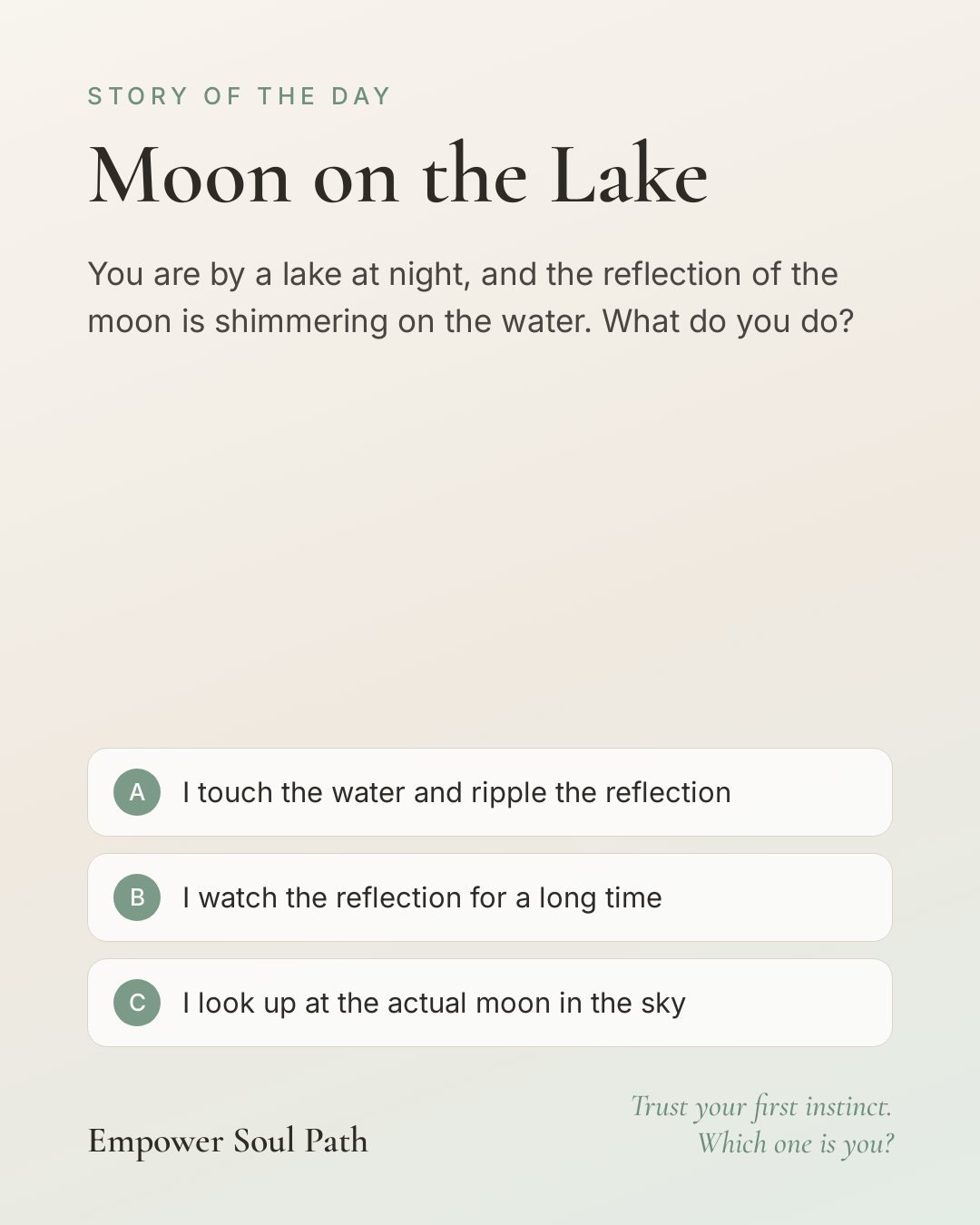
    You are by a lake at night, and the reflection of the moon is shimmering on the water. What do you do?

    What would you choose?

    A. I touch the water and ripple the reflection
    B. I watch the reflection for a long time
    C. I look up at the actual moon in the sky

    Read the scene once, notice which answer your body leans toward first, and go with that. In symbolic stories every choice carries an image, and the image you reach for can say something about where you are right now. There are no right or wrong answers.

    Choose your answer and see what it may reflect: https://app.empowersoulpath.org/s/moon_lake?lang=en

    A question to sit with

    Are you observing your feelings from within right now, or from a bit of a distance? You can write your answer in a journal, or simply hold the question in mind during the day and notice what comes up.

    About symbolic stories

    Symbolic stories are short imagined scenes with a single choice. They are a gentle way to reflect on your inner world, your relationships and your patterns through images rather than analysis. They are a lens for reflection, not a personality test or a diagnosis.

    The Empower Soul Path app has 90 symbolic stories in 9 languages, a discovery journal that keeps your choices, and a monthly symbol map that shows the themes you return to. Try today’s story here: https://app.empowersoulpath.org/s/moon_lake?lang=en

  • The Old Well: A Symbolic Story for Self-Reflection

    The Old Well: A Symbolic Story for Self-Reflection

    Story of the Day from Empower Soul Path, Subconscious Symbols.

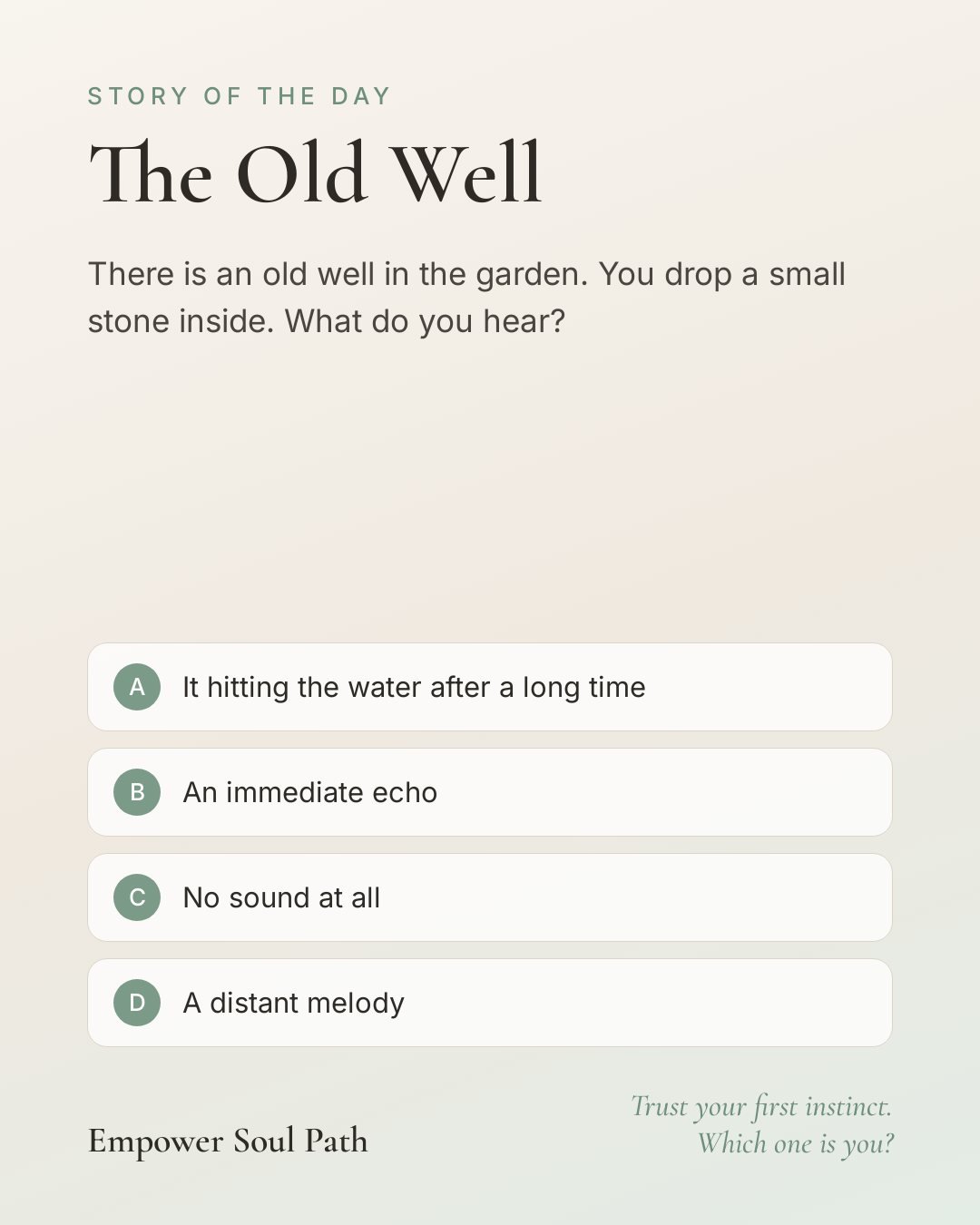
    There is an old well in the garden. You drop a small stone inside. What do you hear?

    What would you choose?

    A. It hitting the water after a long time
    B. An immediate echo
    C. No sound at all
    D. A distant melody

    Read the scene once, notice which answer your body leans toward first, and go with that. In symbolic stories every choice carries an image, and the image you reach for can say something about where you are right now. There are no right or wrong answers.

    Choose your answer and see what it may reflect: https://app.empowersoulpath.org/s/old_well?lang=en

    A question to sit with

    If you could drop a question inside, what kind of answer would you want to hear? You can write your answer in a journal, or simply hold the question in mind during the day and notice what comes up.

    About symbolic stories

    Symbolic stories are short imagined scenes with a single choice. They are a gentle way to reflect on your inner world, your relationships and your patterns through images rather than analysis. They are a lens for reflection, not a personality test or a diagnosis.

    The Empower Soul Path app has 90 symbolic stories in 9 languages, a discovery journal that keeps your choices, and a monthly symbol map that shows the themes you return to. Try today’s story here: https://app.empowersoulpath.org/s/old_well?lang=en

  • Where Do You Feel Anxiety in Your Body? 7 Common Places and What They May Be Telling You

    Short answer: most people feel anxiety in seven places: the chest, the stomach, the throat, the shoulders and neck, the jaw, the hands, and the legs. Anxiety is a whole-body experience. Your nervous system prepares you to act, and that preparation shows up as tightness, flutters, heat, shallow breath or restlessness. Noticing where you feel it is often the first step to feeling calmer.

    Your body usually notices what you feel before your mind can name it. Learning your personal “anxiety map” helps you catch the signal early, while it is still a whisper.

    1. Chest: tightness, pressure or a racing heart

    A tight or heavy chest is one of the most common places people feel anxiety. Breathing tends to move up into the chest and become fast and shallow, which can make the tightness feel stronger. Symbolically, the chest is often linked with the heart, connection and what we hold close.

    Gentle response: place one hand on your chest and slow your exhale so it is longer than your inhale.

    2. Stomach: butterflies, knots or nausea

    The gut and the brain are in constant conversation. When you feel unsafe or uncertain, digestion often slows and the belly tightens. Many people describe a “knot in the stomach” before a hard conversation or a big decision.

    Gentle response: breathe into your belly so your hand rises on the inhale and softens on the exhale.

    3. Throat: a lump or a feeling of being choked up

    A tight throat often appears when there is something we want to say but are holding back. It is the body’s way of bracing around expression.

    Gentle response: hum softly for 30 seconds. The vibration can help the throat and face relax.

    4. Shoulders and neck: lifting, bracing, stiffness

    When we feel on guard, the shoulders rise toward the ears and the neck stiffens, as if protecting the head. Over a long day this can turn into aches and tension headaches. Read more in what tight shoulders may be telling you.

    Gentle response: lift your shoulders up on an inhale, then let them drop heavily on the exhale. Repeat three times.

    5. Jaw: clenching or grinding

    A clenched jaw often holds unspoken frustration or determination to “push through”. Many people only notice it in the afternoon. We explore this in why your jaw tightens in the afternoon.

    Gentle response: let your teeth part slightly and rest your tongue on the floor of your mouth.

    6. Hands: trembling, sweating or fidgeting

    Your hands are ready to act when your nervous system is on alert. Fidgeting, cold fingers or sweaty palms are common signs.

    Gentle response: press your palms together firmly for five seconds, then release and notice the warmth.

    7. Legs: restlessness or the urge to move

    Restless legs or bouncing knees can be the body’s “get ready to go” signal. Movement is not the enemy here. It is energy looking for somewhere to go.

    Gentle response: stand up, feel both feet on the floor, and slowly shift your weight from heel to toe.

    A 2-minute body check-in for anxious moments

    1. Pause: stop what you are doing and take one slow breath.
    2. Locate: ask “where do I feel this right now?” and point to the spot.
    3. Describe: name the sensation in simple words: tight, heavy, buzzing, hot, hollow.
    4. Breathe toward it: imagine your exhale softening that area for five breaths.
    5. Write one line: “Today I felt it in my ___ when ___.” Over time, patterns appear.

    If you want a guided way to do this, the Empower Soul Path app lets you tap where you feel an emotion on an interactive body map, log a quick check-in, and explore what that area may be telling you. It is also available on the web at app.empowersoulpath.org.

    Download it free on Google Play for Android or on the App Store for iPhone.

    Frequently asked questions

    Why do I feel anxiety in my chest?

    When the nervous system goes on alert, breathing often becomes fast and shallow and the chest muscles tighten. This can feel like pressure or tightness. Slower, longer exhales often help the area soften.

    Can anxiety cause physical symptoms?

    Yes. Anxiety commonly shows up as physical sensations such as a racing heart, stomach knots, muscle tension or restlessness. If symptoms are strong, sudden or new, please check in with a healthcare professional.

    How do I find out where I hold anxiety?

    Do a short body check-in once or twice a day and write down where you feel tension. After a week or two, most people notice that the same two or three places come up again and again.

    What is a body map for emotions?

    A body map is a simple outline of the body where you mark where you feel an emotion. It helps you see your personal patterns. Learn more in what is a somatic mood journal.

    A gentle note: this article is for reflection and self-awareness. It is not medical advice and does not replace professional care. If you are going through something heavy, please reach out to a qualified professional or someone you trust.

  • Chest Tightness and Emotions: What Your Body May Be Saying

    Chest Tightness and Emotions: What Your Body May Be Saying

    You notice it before you have a word for it. A band across the chest. A feeling that your breath stops a little short. Maybe it arrived while you were reading a message, or sitting in a meeting, or lying awake at two in the morning with nothing obviously wrong.

    When there is no obvious cause, the first question people ask is usually this one: what does tightness in my chest mean emotionally?

    There is no single answer, and anyone who gives you one quickly is guessing. But there is something useful in the question itself. Tightness in the chest is one of the most common places people feel emotion, and one of the least well described. We have a lot of words for thoughts and very few for sensations. This article is an attempt at some language. Not a diagnosis, not a cause, just a way in.

    The chest is where a lot of feeling gets held

    Some feelings move through us and leave. Others get held, and the chest is one of the places they get held.

    Think about the phrases we already use without noticing: a heavy heart, a weight on the chest, breathing easier now, it took my breath away, I couldn’t speak. These are not medical descriptions. They are the language people reach for when something emotional and something physical arrive at the same time.

    If you feel tightness in your chest, you are not unusual, and you are not broken. You are noticing something. That is the whole starting point.

    What chest tightness is often associated with emotionally

    The associations below are the ones people most often recognise when they slow down and look. They are not causes, and none of them will be true for everyone. Read them as possibilities to test against your own experience, not as a verdict.

    Worry that has not found its shape

    Anxiety is the association people name most often. Not the dramatic kind; the ordinary kind. A low, background anticipation that something needs handling, without a clear sense of what. The chest tightens the way a body braces before a sound it is expecting.

    If this is you, the useful question is not why am I anxious but what am I waiting for? Naming the specific thing, even roughly, often loosens the grip more than trying to relax does.

    Grief, including grief for something small

    Chest tightness is also commonly described alongside loss: a person, a relationship, a version of your life you expected to have. Grief does not only show up after deaths. It shows up after moves, endings, diagnoses, and quiet disappointments that nobody sent a card for.

    The chest is where a sob begins. When crying is not available, because you are at work, because you were taught not to, because it has been a long time, the feeling can stay there as pressure instead.

    Anger you have decided not to have

    Many people have learned early that anger is not safe to express. When it is held back, it does not disappear; it tends to show up as tension in the jaw, the shoulders and the chest. You might feel tight and flat at the same time, which is confusing.

    If this is close to home, ask: what would I say if I knew it would be received well? You do not have to say it to anyone. You only have to let yourself know what it is.

    The fear of being seen, or of speaking

    Tightness in the chest often appears before something that involves being witnessed: a difficult conversation, a presentation, a first date, asking for something you want. The body prepares for exposure by making itself smaller. Breath gets shallow. The chest closes a little.

    Notice whether your tightness has a timing. If it shows up reliably before certain kinds of moments, it is telling you something about the moment, not about your health.

    Overwhelm, when there is too much and no order to it

    Sometimes the chest tightens not because of one feeling but because of too many at once. When several demands arrive together and nothing has been sorted, the body carries the unsortedness. Tightness here is less an emotion than a signal that something needs to be put down or put in order.

    An old protective habit

    Some people have been braced for so long that they cannot remember starting. The chest stays slightly guarded as a default, and it takes a quiet moment to notice the holding is even there. If that sounds familiar, the news is gentle: bracing is a habit, and habits respond to repetition, not to willpower.

    Questions to ask yourself, gently

    If you want to find your own answer rather than borrow one, sit somewhere quiet for a few minutes and take these one at a time. You do not need to answer all of them. You do not need to answer any of them out loud.

    • If this tightness had a sentence, what would it say?
    • When did I first notice it today? What was happening just before?
    • Is it asking me to do something, say something, or stop something?
    • What would it feel like if it eased by ten percent? What would be different?
    • Is there something I have been not-feeling on purpose?

    Whatever comes up, write it down before you judge it. Language is the point. A feeling with a name is easier to be with than a feeling without one.

    Three things to try right now

    These are small on purpose. None of them will fix anything, and that is not what they are for. They are for making the sensation a little more workable.

    1. Make the exhale longer than the inhale. Breathe in through the nose for a count of four, out for a count of six, five times. Do not force it or strain. The longer exhale is a simple way of signalling to the body that the moment is not an emergency. If it makes you dizzy, stop and breathe normally.

    2. Put a hand where the tightness is. Rest your palm flat on your chest and leave it there for a minute. No rubbing, no pressing. Just warmth and weight. Many people find that being touched, even by themselves, changes how a sensation feels.

    3. Look around the room slowly. Let your eyes move without hurrying and name three things you can see and one you can hear. This is called orienting, and it is a way of reminding the body where it actually is, rather than where it is afraid it is.

    What this is not

    Empower Soul Path is a self-reflection app, not a therapist and not a diagnostic tool. Nothing in this article tells you what is causing your chest tightness, and nothing here should be read as a medical opinion. The associations above are ways of finding language for an experience. They are not causes, and they are not certainty.

    If a feeling has a name, it is easier to be with. That is the modest claim we make, and we make only that one.

    When to see a doctor

    Chest tightness can have physical causes, some of them serious, and emotional explanations do not rule those out.

    Seek urgent medical help now if chest tightness comes with any of the following: pain spreading to your arm, jaw, neck or back; shortness of breath at rest; sweating, nausea or dizziness; a feeling of faintness; a rapid or irregular heartbeat; or if the tightness came on suddenly and severely.

    Book an appointment with a doctor if the tightness is new or changing, keeps returning over weeks, wakes you at night, gets worse with exertion, or is accompanied by a persistent cough, fever, or difficulty swallowing. If you have a known heart or lung condition, treat new chest symptoms as something to raise with your doctor rather than something to work through on your own.

    If you are struggling with your mental health and finding it hard to cope, please talk to a doctor or a qualified mental health professional. Reflection is a good companion to care. It is not a substitute for it.

    If you would like to go further

    If the questions above were useful, Body Reflection in Empower Soul Path is built for exactly this. You choose a body area, a sensation and a feeling, and the app shows you what that combination is often associated with emotionally, with questions to sit with and somatic exercises to try. You can save what you notice and come back to it on a harder day.

    It takes a few minutes, it is free to start, and you can try it without deciding anything about yourself.

    Explore Body Reflection →

    Your chest has been trying to say something. You do not have to work out the whole sentence today. Noticing is enough to begin.